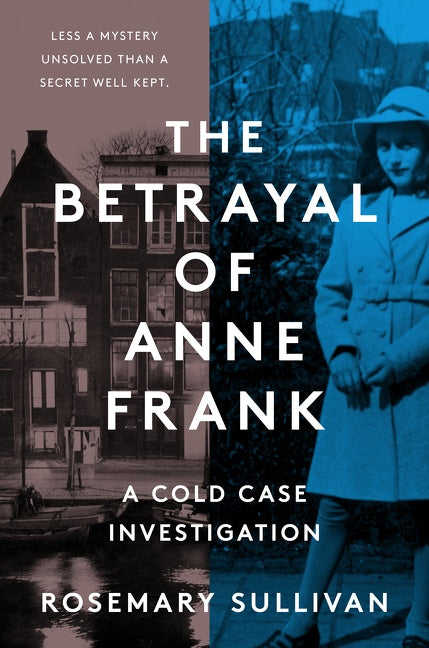
The story of Anne Frank is one that has captivated and moved millions around the globe for generations. Her powerful, poignant voice, captured within the pages of her diary, transports readers to a world of fear, hope, and resilience in the face of unspeakable horror. Tucked away in a secret annex in Amsterdam during the harrowing years of World War II, Anne, her family, and four others sought refuge from Nazi persecution. For 25 long months, they lived in constant dread, their lives a delicate balance between meticulous silence and the ever-present threat of discovery. Then, on August 4, 1944, their hiding place was raided, leading to their arrest and tragic deportation to concentration camps, where Anne, her sister, and mother ultimately perished. Only her father, Otto Frank, survived.
For nearly eight decades, one agonizing question has haunted historians and readers alike: Who betrayed Anne Frank and her family? This mystery, steeped in the passage of time and the deaths of countless potential witnesses, seemed destined to remain unsolved. However, a dedicated international team, leveraging modern investigative techniques and newly unearthed documents, embarked on a five-year journey to finally bring closure to this enduring enigma. Their groundbreaking findings, detailed in a recent, widely acclaimed publication, offer a compelling answer, shaking the very foundations of what we thought we knew about Anne Frank's final days.
The Enduring Legacy of the *Libro Ana Frank*
The impact of Anne Frank's diary, often referred to by its original title or the powerful identifier Libro Ana Frank in many parts of the world, is immeasurable. Translated into countless languages and read by more than 30 million people, it stands as a singular, deeply personal testament to the human spirit amidst profound adversity. When many first encountered this profound work as children or teenagers, myself included, it offered a unique and visceral introduction to the Holocaust, presenting the horror through the eyes of someone their own age.
Her narrative meticulously details the lives of eight individuals — Anne, her parents Otto and Edith, her sister Margot, Hermann and Auguste van Pels, their son Peter, and Fritz Pfeffer — concealed in a small annex above Otto Frank's office in Amsterdam. From June 1942 to August 1944, they navigated the claustrophobia of their existence, the rationing of food, and the constant fear of being heard or discovered. Anne's vivid descriptions of daily life, her adolescent musings, her hopes, and her fears, paint a picture of extraordinary courage and normalcy in the most abnormal of circumstances. To understand the context of her hiding and the events leading up to her betrayal, you can delve deeper into The Diary of Anne Frank: A Teen's WWII Hiding Story, which provides a comprehensive look at this period.
The abrupt end to their sanctuary left an indelible mark on history, prompting endless speculation about the nature of their discovery. Was it a random check? An unfortunate accident? Or, more agonizingly, a deliberate act of treachery? The pursuit of this truth became a moral imperative for generations, understanding that the answer could shed light not only on Anne's fate but on the broader human capacity for cruelty and compassion during wartime.
Unraveling a 75-Year-Old Enigma: The Investigation
The challenge of solving a case nearly 80 years old is immense. Most immediate witnesses were long deceased, documents scattered or destroyed, and memories faded. "We knew it wouldn't be easy," remarked one of the investigators, acknowledging the monumental task. "The question wasn't just 'who,' but 'why.'"
Against this backdrop, an international team, spearheaded by former FBI agent Vincent Pankoke, commenced a meticulous, five-year investigation. This wasn't merely a historical inquiry; it was a cold-case criminal investigation, applying techniques honed in modern law enforcement to a decades-old mystery. Their methodology was sophisticated and exhaustive:
- New Technologies: The team utilized advanced data analysis software, artificial intelligence to process vast amounts of data, and network analysis to map relationships and connections that would have been impossible to discern manually. This allowed them to connect disparate pieces of information and identify patterns previously unseen.
- Rediscovered Documents: Tens of thousands of documents, many previously unexamined, were unearthed from various archives. These included Gestapo files, police reports, business records, and personal testimonies that had lain dormant for decades.
- Sophisticated Investigative Techniques: Employing methods developed by the FBI, Pankoke's team reconstructed the critical months leading up to the arrest. This involved detailed timelines, geographical mapping of individuals' movements, and cross-referencing information from multiple sources to identify inconsistencies or corroborations.
- Interviews with Descendants: Crucially, the team interviewed numerous descendants of individuals who had direct or indirect connections to the Frank family or the Secret Annex. These interviews often yielded fresh perspectives, forgotten family anecdotes, or pointed towards new avenues of inquiry.
The sheer scale and dedication of this effort transformed a seemingly impossible task into a tangible pursuit of truth. For a more detailed account of Anne Frank's personal journey, her hiding, and the broader context of the betrayal, consider reading Anne Frank's Story: Her Diary, Hiding, and Betrayal Uncovered.
The Complexities of Historical Detection
Unlike a modern crime scene, the "evidence" in this case was almost entirely documentary. The challenge lay in piecing together fragments of information, understanding the political climate of Nazi-occupied Holland, and navigating the biases inherent in wartime records and post-war testimonies. The investigators had to consider multiple theories, from accidental discovery to various potential betrayers, carefully weighing each piece of evidence to build a coherent and credible narrative.
The Shocking Conclusion: Who Was the Betrayer?
After years of relentless investigation, sifting through mountains of data and countless testimonies, the team arrived at a compelling conclusion. Their research points to a Jewish notary named Arnold van den Bergh as the most likely betrayer of the Frank family. The motive, they posit, was not ideological but born out of a desperate attempt to save his own family. Van den Bergh, who was himself in hiding, was a member of the Jewish Council, an administrative body established by the Nazis. He likely had access to lists of addresses of Jews in hiding, which he may have traded to the Nazis to ensure the safety of his own family, albeit temporarily.
This revelation is particularly poignant and complex, as it highlights the unimaginable moral dilemmas and impossible choices forced upon individuals under Nazi persecution. It’s a stark reminder that even within the victimized community, the lines between victim and perpetrator could become tragically blurred under extreme duress. The "why" behind the betrayal, therefore, becomes a crucial lens through which to understand the human cost of the Holocaust, extending beyond mere malice to encompass the profound survival instincts ignited by terror.
While the evidence gathered is substantial and compelling, the investigators acknowledge that, given the passage of time, absolute 100% certainty might remain elusive. However, the depth of their research and the rigorous methodology employed make this the most credible and comprehensively supported theory to date.
Beyond the Betrayal: Lessons from Anne Frank's Story and the Investigation
The resolution of Anne Frank's betrayal offers more than just an answer to a historical question; it provides profound insights and lessons for contemporary society:
- The Power of Persistent Inquiry: The investigation demonstrates that even the oldest and most complex historical mysteries can be unraveled with dedication, innovative techniques, and a commitment to truth. It serves as an inspiration for ongoing historical research and critical examination of past events.
- Understanding Human Complexity: The suspected betrayer's motive forces us to confront the uncomfortable realities of survival during genocide. It encourages a nuanced understanding of human behavior under extreme pressure, challenging simplistic narratives of good and evil.
- The Enduring Relevance of the *Libro Ana Frank*: This new chapter in Anne Frank's story reinforces the importance of her diary not just as a historical document, but as a living testament to the human experience. It compels new generations to read and reflect on her words, understanding the dangers of intolerance and the preciousness of human dignity.
- Technology as a Historical Tool: The success of this investigation underscores the invaluable role modern technology, from AI to advanced data analysis, can play in historical research, allowing us to connect dots that were invisible to previous generations of scholars.
- Preserving Memory: The continuous effort to understand Anne Frank's story underscores our collective responsibility to preserve the memory of the Holocaust and other atrocities. It's a call to action to educate, to remember, and to never forget the lessons of history.
These insights are not just academic; they offer actionable advice for navigating our world today. They remind us to approach complex situations with critical thinking, to seek out comprehensive truths, and to never cease questioning, especially when confronted with injustice or historical gaps.
Conclusion
The mystery of who betrayed Anne Frank, a question that has lingered for nearly eight decades, has finally found its most plausible answer thanks to extraordinary investigative efforts. This groundbreaking research, vividly detailed in the influential book chronicling the investigation (another vital Libro Ana Frank in its own right), not only brings a measure of closure to a painful chapter of history but also profoundly enriches our understanding of the Holocaust. It reminds us of Anne Frank's enduring legacy, the profound moral complexities faced by individuals during wartime, and the relentless human quest for truth. As we reflect on her story and the recent revelations, Anne Frank's voice continues to resonate, urging us to confront hatred, champion empathy, and tirelessly work towards a world where no one is forced to hide in fear.